Example: a small agentic dev team
Two people and two coding agents share issues, tasks, and pull requests. Agents claim work, spend their own budgets, and submit code; CI receives signed webhooks and reports back; reviews follow the team's rules; a maintainer's assistant approves over MCP; and the team's git host is connected, so an agent reads only the repositories it is allowed. No server feature was added for it.
This page walks through one complete scenario: the model, the actions, the CI integration, and every request in order, including the ones that are refused. Everything here uses the public API, so you can load the same model into your own organization and replay it. The model needed nothing beyond the features the other examples use.
Who takes part
| Identity | Connects with | Teams | |
|---|---|---|---|
| Dana, a maintainer | a person, in your app and through an assistant | REST, with a session token; MCP, with an OAuth grant of ontology:read actions:apply, and a personal MCP token of connectors:use connectors:write | developers, maintainers |
| Eli, a developer | a person, in your app | REST, with a session token | developers |
| ada and bix | coding agents, as agent accounts | REST, with API tokens; ada also MCP, with an MCP token of connectors:use | developers, agents |
| ci-bot | the CI system’s agent account | REST, with an API token | ci |
No team holds a write permission. Everything below changes only through
actions, so an agent’s API token can claim a task or submit a pull request,
but cannot edit a task’s claimant or a pull request’s CI result directly
(403).
The model
| Object type | Holds |
|---|---|
repo | name (unique), default_branch, and the review policy agents_review_agents |
issue | number (a sequence), title, body, reporter, status |
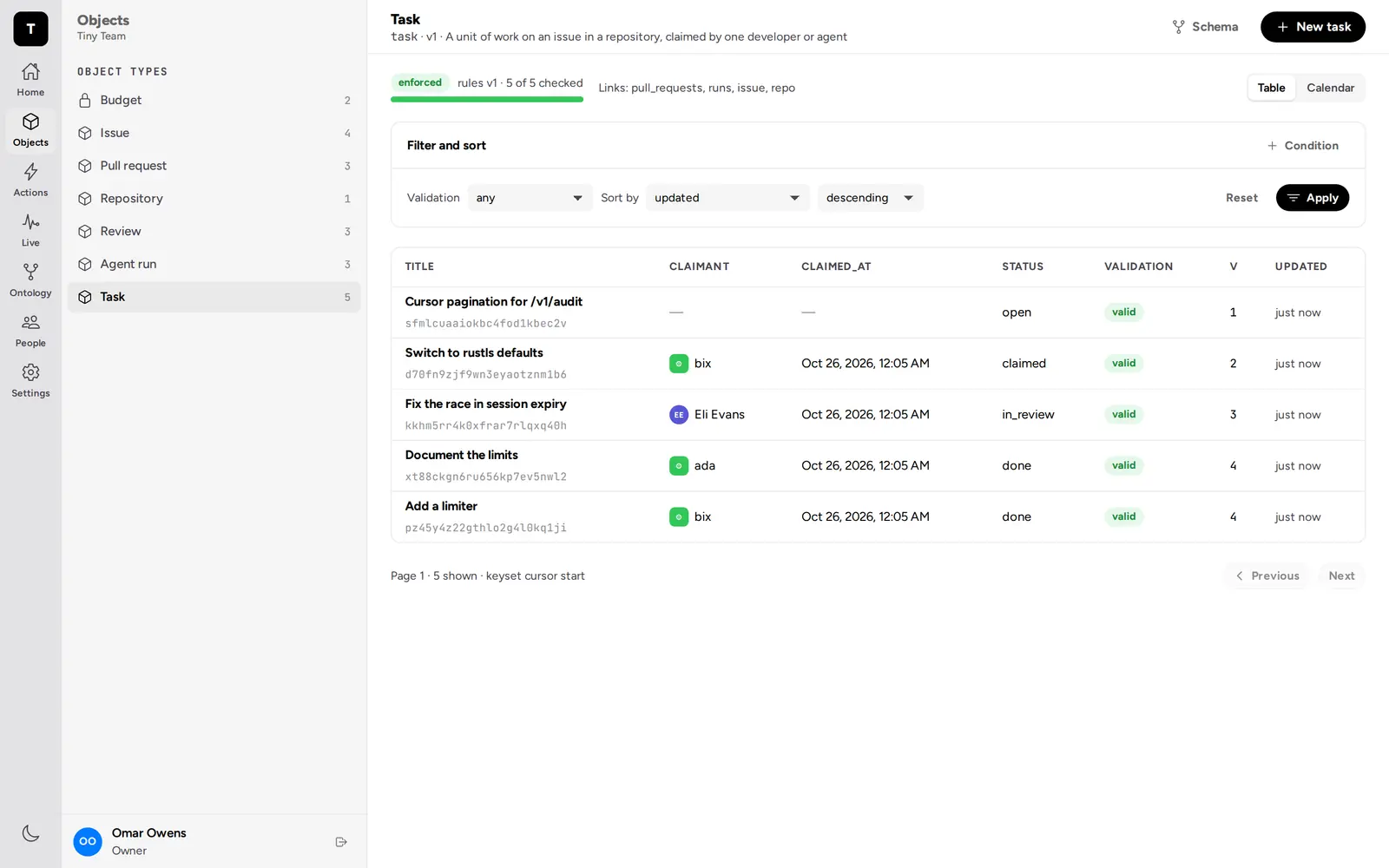
task | title, claimant, claimed_at, status: open, claimed, in_review, or done |
pull_request | number (a sequence), title, author, head_sha, status, ci_status and ci_sha, approved_by and approved_sha, merged_by, merged_at |
review | reviewer, reviewer_kind, sha, verdict: approve or request_changes; body |
budget | agent, limit, spent, in credits |
run | agent, estimate, cost, status, started_at, finished_at |
Commit shas are strings with a regex rule. Links join a task to its issue
and repository, a pull request to its task and repository, a review to its
pull request, and a run to its task and budget.
The seed creates the api repository, with agents_review_agents off, and
two budgets: 50 credits for ada and 20 for bix.
Budgets are private
Every type is visible to every member except budget, which is restricted
with agent as its
access property:
PUT /v1/ontology/object-types/budget/access
{ "restricted": true, "access_properties": ["agent"],
  "grants": [
    { "team_id": "<agents>", "permission": "view_objects", "scope": "assigned" },
    { "team_id": "<maintainers>", "permission": "view_objects" } ] }
Each agent sees its own budget and maintainers see all of them. Another agent’s budget does not exist for an agent, so it cannot even name one in an action.
The actions
| Action | Granted to | Does |
|---|---|---|
open_issue | developers | files a numbered issue |
plan_task | maintainers | adds a task for an open issue in a repository |
claim_task | developers | takes an open task; a task has one claimant |
start_run | agents | reserves credits from the caller’s own budget for work on the caller’s task |
finish_run | agents | records what the run cost, and charges the budget that instead of the estimate |
submit_pr | developers | opens a numbered pull request for the task the caller claimed; tells CI |
push_commits | developers | moves the caller’s pull request to a new head commit, resetting its approval and CI result; tells CI |
report_ci | ci | records the CI result for the pull request’s head commit only |
review_pr | developers | approves the head commit or requests changes |
merge_pr | maintainers | merges a pull request approved and passed at its head, and completes the task |
set_review_policy | maintainers | allows or forbids agents approving agents’ pull requests in a repository |
One claimant per task
claim_task is one criterion and one update:
{ "criteria": [
    { "name": "unclaimed", "message": "the task is claimed already",
      "condition": { "op": "eq", "left": { "object": "task", "property": "status" },
                     "right": { "value": "open" } } } ],
  "edits": [
    { "op": "update_object", "object": { "param": "task" },
      "properties": { "claimant": { "caller": "id" }, "claimed_at": { "now": true },
                      "status": { "value": "claimed" } } } ] }
The criterion alone would not be enough if two agents read the open task at
the same moment. But an action locks its objects and checks their versions
again before it writes, so of two concurrent claims one commits and the other
gets 409 version_conflict, or, if it reads the task after the first
committed, 422 at criteria.unclaimed.
Budgets
start_run takes the task, a budget, and an estimate. Its criteria check
that the task is the caller’s, that the budget is the caller’s, and, in
Python, that the estimate fits:
def check(ctx):
    b = ctx['objects']['budget']['properties']
    left = b['limit'] - b['spent']
    if ctx['params']['estimate'] > left:
        return 'the run needs ' + str(ctx['params']['estimate']) + ' credits; ' + str(left) + ' are left'
    return True
The edits create the run, link it, and add the estimate to spent.
finish_run replaces the estimate with the cost, after a linked criterion
checks that the run was charged to that budget.
Review rules
review_pr has six criteria:
| Criterion | Holds when |
|---|---|
open | the pull request is open or approved |
of_repo | it belongs to the repository passed (linked) |
current | the review is of the pull request’s head_sha |
not_author | the caller is not its author |
agent_reviews | the caller is a human, or the author is, or the repository’s agents_review_agents is on |
maintainer_approves_agents | an approval by a person of an agent’s pull request comes from a maintainer |
{ "name": "agent_reviews",
  "message": "agents review agents' pull requests only where the repository allows it",
  "condition": { "op": "or", "conditions": [
    { "op": "eq", "left": { "caller": "kind" }, "right": { "value": "human" } },
    { "op": "eq", "left": { "user": { "object": "pull_request", "property": "author" }, "field": "kind" },
      "right": { "value": "human" } },
    { "op": "eq", "left": { "object": "repo", "property": "agents_review_agents" }, "right": { "value": true } } ] } }
{"user": ..., "field": "kind"} looks up the kind of the user in the pull
request’s author, so nothing about the author is copied onto the pull
request. The last criterion checks a team:
{ "name": "maintainer_approves_agents",
  "message": "only maintainers approve an agent's pull request for people",
  "condition": { "op": "or", "conditions": [
    { "op": "ne", "left": { "param": "verdict" }, "right": { "value": "approve" } },
    { "op": "eq", "left": { "caller": "kind" }, "right": { "value": "agent" } },
    { "op": "eq", "left": { "user": { "object": "pull_request", "property": "author" }, "field": "kind" },
      "right": { "value": "human" } },
    { "op": "contains", "list": { "caller": "teams" }, "value": { "team": "maintainers" } } ] } }
Any developer may request changes, but when a person approves an agent’s
work, that person is on maintainers. Agents reviewing agents are governed by
agent_reviews instead.
merge_pr checks that the pull request is approved at its head and that CI
passed the head, so a push after an approval needs a new approval and a new
CI result.
CI as a webhook receiver
submit_pr, push_commits, and merge_pr each have a webhook effect to
CI. CI is an ordinary HTTPS server:
- At setup, it reads each action type’s webhook secret as an owner:
GET /v1/ontology/action-types/submit_pr/webhook-secret, and the same forpush_commitsandmerge_pr. - For each delivery, it picks the secret by the payload’s
actionand checksx-happy-enterprise-signature:sha256=and the hex HMAC-SHA256 of"<x-happy-enterprise-timestamp>.<body>". Anything else is refused. - It builds the commit in
params.sha, and reports back as ci-bot:
POST /v1/actions/report_ci/apply
Authorization: Bearer heat_...
{ "params": { "pull_request": "<pr>", "sha": "a1b2c3d", "passed": true },
  "idempotency_key": "<x-happy-enterprise-delivery>" }
The delivery id is the same on every redelivery of a webhook, so using it
as the idempotency key turns a redelivered webhook into a replay, not a
second report. report_ci only accepts the pull request’s current head, so
a slow build of an older commit cannot mark a newer one as passed. See
Effects for the webhook format.
Setting it up
As an owner, through the REST API:
- Create the four teams, with no permissions, and the three agent accounts
(members API, teams API). Add
Dana, Eli, ada, and bix to
developers, Dana tomaintainers, ada and bix toagents, and ci-bot toci. - Create the object types and link types
(schema API), and restrict
budgetas above. - Create the action types and grant each to its teams (actions API), and give CI the three webhook secrets.
- Create the repository and the two budgets.
- Connect the team’s git host (see 8. The git host).
1. Dana plans the work
Dana opens issue 1, “Rate-limit the login endpoint”, and plans two tasks for
it in api: “Add a limiter” and “Document the limits”. Eli trying
plan_task gets 403: it is granted to maintainers only. ada trying to
PATCH itself in as the limiter’s claimant also gets 403.
2. Two agents, one task
ada and bix claim the limiter at the same moment:
POST /v1/actions/claim_task/apply
{ "params": { "task": "<limiter>" } }
One gets 201. The other gets 409 version_conflict, or 422 at
criteria.unclaimed if it arrived after the first committed. Say ada won.
bix claiming the limiter again gets criteria.unclaimed, and takes the docs
task instead.
3. Runs and budgets
Refused by a criterion. bix asks for a 25-credit run on the docs task, from a 20-credit budget:
422 { "error": { "code": "criteria_failed",
      "details": [{ "path": "criteria.within_budget",
                    "message": "the run needs 25 credits; 20 are left" }] } }
Refused as unknown. bix tries to charge ada’s budget instead: 422 at
params.budget. To bix, ada’s budget does not exist; asking for it by id is
404.
bix starts a 15-credit run. ada starts an 18-credit run on the limiter and finishes it at a cost of 12, so ada’s budget shows 12 spent. Dana, a maintainer, sees both budgets.
4. A pull request, and CI
ada submits the limiter as commit a1b2c3d, with an idempotency key. The
answer is lost and ada sends it again: 200, replayed: true. There is one
pull request, number 1, with ada as its author and ci_status: "pending", and the task is in_review.
After commit, CI receives one submit_pr delivery, not two: the replay
applied nothing, so it queued no effect. CI verifies the signature and
reports a1b2c3d as passed with the delivery id as its key. A redelivery’s
report is a replay.
5. Reviews
Refused by the policy. bix approves ada’s pull request:
criteria.agent_reviews. Agents do not approve agents in api.
Refused twice. ada approves ada’s own pull request. Both reasons come
back: criteria.not_author and criteria.agent_reviews.
Refused by a team check. Eli approves ada’s pull request:
criteria.maintainer_approves_agents. Eli is a developer, not a maintainer.
Eli requests changes instead. ada pushes commit e4f5a6b: the pull request is
open again, and its CI result pending.
Refused as stale. CI’s late report for a1b2c3d arrives now: 422 at
criteria.head, “the pull request moved on to another commit”. The
push_commits delivery comes in, and CI reports e4f5a6b as passed.
6. Dana’s assistant approves
Dana’s MCP client lists the open pull requests (query_objects with
status = open) and finds one. It approves the commit it saw first:
{ "tool": "action_review_pr",
  "arguments": { "pull_request": "<pr>", "repo": "<api>", "sha": "a1b2c3d",
                 "verdict": "approve", "body": "Approved by Dana's assistant" } }

→ error { "code": "criteria_failed",
          "details": [{ "path": "criteria.current", "message": "review the pull request's head commit" }] }
With e4f5a6b, the head, it succeeds. The approval is Dana’s: the pull
request’s approved_by is Dana, and the audit log records the application
as kind: human, via: mcp.
Eli tries to merge: 403. Dana merges: the pull request is merged, the
task done, and CI’s merge_pr webhook is sent.
7. Agents review agents
Dana turns agents_review_agents on for api (set_review_policy). bix
finishes its run at a cost of 9, and submits the docs as pull request 2,
commit 0c0ffee. ada approves it, which the policy now allows.
Dana tries to merge before CI has reported: 422 at criteria.ci_passed.
CI reports, and Dana merges.
8. The git host
The team’s git host is an MCP server with three tools: list_repos and
read_file {repo, path}, which read, and comment {repo, issue, text},
which writes. It holds the repositories api, docs, and infra, and
infra holds production secrets. The owner
connects it with the credential the git host
gave the team:
POST /v1/connectors
{ "name": "git", "display_name": "Tiny git host", "url": "https://git.tinyteam.example/mcp",
  "auth": { "kind": "bearer", "token": "..." } }
POST /v1/connectors/git/sync lists the three tools as pending. The
owner reads each definition and enables it by its hash, marking comment
as a write:
PATCH /v1/connectors/git/tools/comment
{ "state": "enabled", "hash": "<the reviewed hash>", "access": "write" }
Then the grants:
| Tool | agents | maintainers |
|---|---|---|
list_repos | yes | yes |
read_file | only {"repo": {"allow": ["api", "docs"]}} | any repository |
comment | no | yes |
The owner issues ada an
MCP token of connectors:use, for 30
days:
POST /v1/mcp-tokens
{ "name": "ada", "scopes": ["connectors:use"], "user": "<ada>", "expires_in_days": 30 }

201 { "id": "<token>", "token": "hemt_...", "scopes": ["connectors:use"], ... }
ada reads api. With that token, ada’s tools/list shows exactly
git.list_repos and git.read_file, and read_file’s repo is an enum of
api and docs. Reading api’s README.md returns the file, after a line
marking it as external content.
Refused: infra. ada asks for infra’s README.md. The grant allows
only api and docs, so the call is a tool error and never reaches the git
host.
Refused: commenting. git.comment is not granted to agents, and
ada’s token lacks connectors:write besides, so the call is a tool error.
Dana comments. Dana issues a personal token of connectors:use connectors:write, and comments “on it” on api issue 1. The git host
receives the comment from the team’s credential: every call goes out as
the same remote identity.
The call log (GET /v1/connectors/git/calls) shows all four calls, oldest
first:
| Tool | By | Status |
|---|---|---|
read_file (api) | ada | ok |
read_file (infra) | ada | denied |
comment | ada | denied |
comment | Dana | ok |
What everyone saw
The audit log tells people, agents, and the assistant apart. Its three reviews, newest first:
| Review | kind | via |
|---|---|---|
| ada approves pull request 2 | agent | rest |
| Dana’s assistant approves pull request 1 | human | mcp |
| Eli requests changes on pull request 1 | human | rest |
Every refused request, and both replays, left no record and changed nothing.
What this shows
- Agents are members with rules, not admins with tokens. The coding agents hold no write permission. They claim, spend, and submit only through actions that check the task is theirs and the budget is theirs.
- Races have one winner. Two agents claiming one task cannot both get it; the loser is told why.
- Review policy is data. Who may approve whom is in the criteria, in the teams people are on, and in a repository flag a maintainer sets, and it applies to every caller alike.
- Integrations get the same guarantees. CI verifies where a webhook came from, reports through an action, and its retries and late results are harmless.
- An assistant acts as its person. Dana’s assistant can approve because Dana can, and the log says it was Dana, through MCP.
- Outside tools are granted, not handed over. Agents never hold the git host’s credential. They call only the reviewed tools granted to their team, with the arguments their grant allows, and every call, refused or not, is in the log.
What it does not do yet
- One identity at the git host. The git host sees every call as the team’s credential, not as ada or Dana; only the call log tells them apart.
- Budgets do not reset in this example. A schedule per budget could apply a reset action each period; none is set up. Run costs are what the agents report, not metered.
- The git host’s commits are not the pull requests’ commits. The shas on pull requests are the ones agents and CI report.