Example: machine maintenance
A machine breaks down. An agent reports and assigns the incident in a channel about it, a technician's assistant reads that channel and does the work over MCP, and a supervisor approves the close. All three change the same objects, only through actions, and every refusal is explained.
This page walks through one complete scenario: the model, the three actions, and every request in order, including the ones that are refused. Everything here uses the public API, so you can load the same model into your own organization and replay it.
Who takes part
| Identity | Connects with | Team | |
|---|---|---|---|
| dispatch-bot | an agent account | REST, with its API token | dispatch |
| Tess, a technician | a person, through an assistant | MCP, with an OAuth grant of ontology:read actions:apply chat:read | technicians |
| Sam, a supervisor | a person, in your app | REST, with a session token, watching the event stream | supervisors |
Only dispatch holds a permission to write (edit_objects), so the agent
can report incidents directly. Technicians and supervisors hold no write
permission at all. They change incidents, work orders, and machines only
through the actions granted to them: each grant stands in for edit_objects
for that action’s edits, and nothing else.
The model
| Object type | Properties |
|---|---|
machine | name (unique), site, status: running, down, or maintenance |
incident | title, severity: low, medium, or high; status: open, assigned, in_progress, awaiting_approval, or closed; assignee, notes, resolution, close_requested_by, closed_by, approved_by, closed_at |
assignment | team, assignee, assigned_by, assigned_at, note: one team assignment of an incident |
work_order | summary, priority: normal or urgent; status, opened_by |
| Link type | From → to | Cardinality | Names |
|---|---|---|---|
incident_machine | incident → machine | many to one | machine / incidents |
incident_assignments | incident → assignment | one to many | assignments / incident |
order_incident | work order → incident | many to one | incident / work_orders |
order_machine | work order → machine | many to one | machine / work_orders |
The status properties are enum rules and the people are user_ref
properties, so every write, whether from an action or not, is checked against
them. Two machines are seeded: Press 7 and Conveyor 2, both running.
Who sees which incidents
incident is a restricted type with assignee as its
access property:
| Team | Sees |
|---|---|
dispatch | every incident, and may edit them (view_objects and edit_objects, scope all) |
supervisors | every incident (view_objects, scope all) |
technicians | only the incidents assigned to them (view_objects, scope assigned) |
PUT /v1/ontology/object-types/incident/access
{ "restricted": true, "access_properties": ["assignee"],
  "grants": [
    { "team_id": "<dispatch>", "permission": "view_objects" },
    { "team_id": "<dispatch>", "permission": "edit_objects" },
    { "team_id": "<supervisors>", "permission": "view_objects" },
    { "team_id": "<technicians>", "permission": "view_objects", "scope": "assigned" } ] }
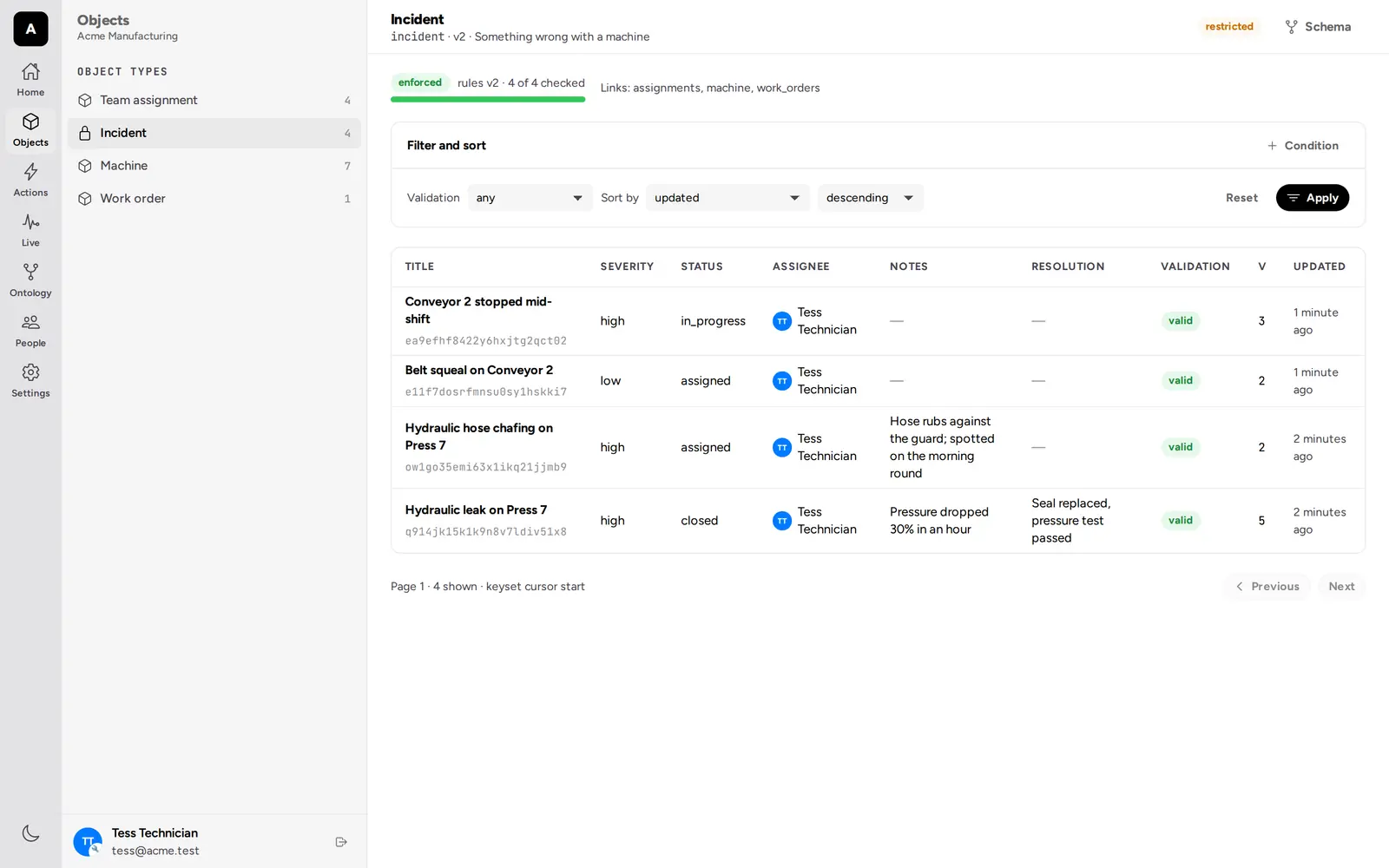
Postgres enforces it, so Tess’s assistant cannot see or name an incident that is not assigned to Tess by any route: queries, links, MCP tools, or actions.
A channel per incident
incident_chat is a chat type about incidents. Each
incident gets a public channel about it, and a message field kind marks
a report, an update, or a question:
{ "api_name": "incident_chat", "display_name": "Incident chat", "kind": "chat",
  "chat": { "object_type": "incident", "retention_days": 365 },
  "properties": [
    { "api_name": "kind", "type": { "kind": "string" },
      "rules": [{ "rule": "enum", "values": ["report", "update", "question"] }] } ] }
It is restricted: dispatch may read and write in it, supervisors and
technicians may read. A channel about an incident is seen only by whoever
sees the incident, so Tess sees the channel of the incident assigned to
Tess, and no other.
The actions
| Action | Granted to | Does |
|---|---|---|
assign_incident | dispatch, supervisors | records a team assignment, links it, sets the incident to assigned with its assignee, and emails the assignee |
create_maintenance_order | technicians | the incident’s assignee opens a work order, links it to the incident and the machine, sets the incident in_progress and the machine to maintenance, and sends a webhook |
close_incident | technicians, supervisors | closes the incident; a high-severity one is first submitted, then approved by someone else; emails the assignee |
assign_incident
{
  "api_name": "assign_incident",
  "display_name": "Assign an incident",
  "parameters": [
    { "api_name": "incident", "object_type": "incident",
      "required": true },
    { "api_name": "team", "type": { "kind": "string" },
      "required": true, "rules": [{ "rule": "cuid" }] },
    { "api_name": "assignee", "type": { "kind": "user_ref" },
      "required": true },
    { "api_name": "note", "type": { "kind": "string" } }
  ],
  "criteria": [
    { "name": "assignable",
      "message": "only open or assigned incidents can be assigned",
      "condition": { "op": "in",
        "left": { "object": "incident", "property": "status" },
        "values": [{ "value": "open" }, { "value": "assigned" }] } }
  ],
  "edits": [
    { "op": "create_object", "type": "assignment",
      "ref": "assignment",
      "properties": {
        "team": { "param": "team" },
        "assignee": { "param": "assignee" },
        "assigned_by": { "caller": "id" },
        "assigned_at": { "now": true },
        "note": { "param": "note" } } },
    { "op": "create_link", "link": "incident_assignments",
      "from": { "param": "incident" },
      "to": { "created": "assignment" } },
    { "op": "update_object", "object": { "param": "incident" },
      "properties": { "status": { "value": "assigned" },
                      "assignee": { "param": "assignee" } } }
  ],
  "effects": [
    { "kind": "email", "to": { "param": "assignee" },
      "subject": "Incident assigned to you: {{object.incident.title}}",
      "text": "{{object.incident.title}} ({{object.incident.severity}}) is yours. Note: {{param.note}}" }
  ]
}
create_maintenance_order
Two criteria: the incident is assigned or in_progress, and the caller
is its assignee. Only the technician the incident was handed to may open a
work order for it.
"criteria": [
  { "name": "in_hand",
    "message": "the incident must be assigned or in progress",
    "condition": { "op": "in",
      "left": { "object": "incident", "property": "status" },
      "values": [{ "value": "assigned" }, { "value": "in_progress" }] } },
  { "name": "assignee",
    "message": "only the incident's assignee opens work orders",
    "condition": { "op": "eq",
      "left": { "caller": "id" },
      "right": { "object": "incident", "property": "assignee" } } }
],
"edits": [
  { "op": "create_object", "type": "work_order", "ref": "order",
    "properties": { "summary": { "param": "summary" },
                    "priority": { "param": "priority" },
                    "status": { "value": "open" },
                    "opened_by": { "caller": "id" } } },
  { "op": "create_link", "link": "order_incident",
    "from": { "created": "order" }, "to": { "param": "incident" } },
  { "op": "create_link", "link": "order_machine",
    "from": { "created": "order" }, "to": { "param": "machine" } },
  { "op": "update_object", "object": { "param": "incident" },
    "properties": { "status": { "value": "in_progress" } } },
  { "op": "update_object", "object": { "param": "machine" },
    "properties": { "status": { "value": "maintenance" } } }
],
"effects": [
  { "kind": "webhook",
    "url": "https://hooks.example.com/maintenance/orders" }
]
close_incident
A declarative criterion (not_closed) plus a Python one for the four-eyes
rule, and Python edits, because what closing does depends on the incident.
def check(ctx):
    incident = ctx['objects']['incident']['properties']
    if incident.get('severity') != 'high':
        return True
    requester = incident.get('close_requested_by')
    if requester is None:
        if ctx['params'].get('resolution') is None:
            return 'say what was done (resolution) to submit the incident for closing'
        return True
    if requester == ctx['caller']['id']:
        return 'a high-severity incident needs approval by someone other than whoever submitted it'
return Truedef edits(ctx):
incident = ctx['objects']['incident']['properties']
me = ctx['caller']['id']
target = {'param': 'incident'}
if incident.get('severity') == 'high' and incident.get('close_requested_by') is None:
changes = {'status': 'awaiting_approval', 'close_requested_by': me,
'resolution': ctx['params']['resolution']}
return [{'op': 'update_object', 'object': target, 'properties': changes}]
changes = {'status': 'closed', 'closed_by': me, 'closed_at': ctx['now']}
if incident.get('severity') == 'high':
changes['approved_by'] = me
elif ctx['params'].get('resolution') is not None:
changes['resolution'] = ctx['params']['resolution']
return [{'op': 'update_object', 'object': target, 'properties': changes}]The edits’ definition names no object types to create and no link types, so the code can only update the incident it was given.
Setting it up
As an owner, through the REST API:
- Create the three teams and give
dispatchtheedit_objectspermission (teams API). Add Sam tosupervisors, Tess totechnicians, and the agent todispatch. - Create the object types, the
incident_chatchat type, and the link types (schema API), and restrictincidentandincident_chatas above. - Create the three action types and grant each to its teams
(
PUT /v1/ontology/action-types/{type}/access, actions API). - Create the two machines.
1. The agent reports and assigns
dispatch-bot reports the incident and links it to Press 7. It may, because
dispatch holds edit_objects.
POST /v1/ontology/objects/incident
Authorization: Bearer heat_...
{ "properties": { "title": "Hydraulic leak on Press 7", "severity": "high",
                  "status": "open", "notes": "Pressure dropped 30% in an hour" } }

201 { "id": "<incident>", "version": 1, ... }

PUT /v1/ontology/links/incident_machine/<incident>/<press 7>
It opens the incident’s channel and posts the report there:
POST /v1/chat/channels
{ "type": "incident_chat", "kind": "public", "name": "press-7-leak", "object": "<incident>" }

201 { "id": "<channel>", "object": "<incident>", ... }

POST /v1/chat/channels/<channel>/messages
{ "text": "Pressure dropped 30% in an hour; Press 7 is down", "fields": { "kind": "report" } }
It also reports a second, low-severity incident, “Belt squeal on Conveyor
2”, which nobody is assigned yet, with its own channel,
conveyor-2-belt. Then it assigns the leak to Tess, with an idempotency
key:
POST /v1/actions/assign_incident/apply
{ "params": { "incident": "<incident>", "team": "<technicians team>",
              "assignee": "<tess>", "note": "Seal kit is in bay 3" },
  "idempotency_key": "assign-<incident>" }

201 { "application_id": "<a1>", "applied_by": { "kind": "agent", "via": "rest", ... },
      "created": [{ "type": "assignment", "ref": "assignment", ... }],
      "updated": [{ "type": "incident", "version": 2, ... }], "replayed": false, ... }
Suppose the answer is lost on the way back. The agent sends the same request
again and gets the first result back, 200 with replayed: true and the
same application_id. Nothing is applied twice and no second email goes
out. Tess receives “Incident assigned to you: Hydraulic leak on Press 7”.
The agent tells the channel too, mentioning Tess: “Assigned to
<@tess>. Seal kit is in bay 3”.
2. The technician’s assistant does the work
Tess connects an MCP client to the organization and grants it
ontology:read actions:apply chat:read. Its tools include action_close_incident and
action_create_maintenance_order, but not action_assign_incident:
technicians are not granted it.
Asked for every incident (query_objects on incident, no filter), the
assistant gets one: the leak. The belt squeal exists, but it is not assigned
to Tess, so for Tess it does not. It narrows the query anyway (whoami
gives Tess’s id):
{ "tool": "query_objects",
  "arguments": { "type": "incident", "filter": { "op": "and", "filters": [
    { "op": "eq", "property": "assignee", "value": "<tess>" },
    { "op": "eq", "property": "status", "value": "assigned" } ] } } }
It gets the leak at version 2, finds its machine by following the link
(query_objects on machine with {"op": "linked", "link": "incidents", "object": "<incident>"}), and calls list_actions: close_incident and
create_maintenance_order.
It lists the channels it can read (list_channels) and gets one, the leak’s
press-7-leak; conveyor-2-belt is about an incident Tess does not see.
read_messages on it returns the report and the assignment update. With
chat:read only, it can read the channel but not post in it.
Denied. Asked to reassign the incident, it tries anyway:
{ "tool": "action_assign_incident",
  "arguments": { "incident": "<incident>", "team": "<technicians team>", "assignee": "<tess>" } }

→ error { "code": "forbidden" }
Applied. It opens a work order, stating the version it read:
{ "tool": "action_create_maintenance_order",
  "arguments": { "incident": "<incident>", "machine": "<press 7>",
                 "summary": "Replace the main cylinder seal", "priority": "urgent",
                 "idempotency_key": "order-1",
                 "expected_versions": { "incident": 2 } } }

→ { "application_id": "<a2>", "applied_by": { "kind": "human", "via": "mcp", ... },
    "created": [{ "type": "work_order", "ref": "order", ... }],
    "links": [ ... 2 created ... ],
    "updated": [{ "type": "incident", "version": 3, ... }, { "type": "machine", ... }] }
The work order, both links, the incident’s new status, and the machine’s
new status commit together. Retrying with the same key returns the same work
order (replayed: true).
Conflict. Next it submits the close, still stating version 2. The work order moved the incident to version 3, so nothing is applied:
{ "tool": "action_close_incident",
  "arguments": { "incident": "<incident>",
                 "resolution": "Seal replaced, pressure test passed",
                 "expected_versions": { "incident": 2 } } }

→ error { "code": "version_conflict",
          "details": [{ "path": "params.incident", "message": "..." }] }
It reads the incident again (get_object: version 3, in_progress) and
submits with version 3. The incident is high severity and has no close
request yet, so the edits set it to awaiting_approval with
close_requested_by = Tess and the resolution.
Refused by a criterion. Asked to finish the job, it tries to approve the close itself:
→ error { "code": "criteria_failed",
          "details": [{ "path": "criteria.four_eyes",
                        "message": "a high-severity incident needs approval by someone other than whoever submitted it" }] }
3. The supervisor approves
Sam’s app has been following the event stream all along, so the incident awaiting approval is already on screen. Sam approves over REST with a session token:
POST /v1/actions/close_incident/apply
{ "params": { "incident": "<incident>" } }

201 { "updated": [{ "type": "incident", "version": 5, ... }], ... }
The incident now reads status: closed, close_requested_by = Tess,
approved_by = Sam, and Tess’s resolution. Its work_orders link leads to
the work order, and Press 7 is in maintenance.
What everyone saw
Sam’s event stream carried every change, whoever made it and however they
connected: the object.created, object.updated, and link.created events
of each edit, the chat.message.created events of the incidents’ channels,
and four action.applied events:
| Action | Via |
|---|---|
assign_incident | rest (dispatch-bot) |
create_maintenance_order | mcp (Tess) |
close_incident (submit) | mcp (Tess) |
close_incident (approve) | rest (Sam) |
The refused calls appear nowhere: they changed nothing.
The audit log (GET /v1/action-applications, newest first) records how
each application was authenticated:
| Action | Method | Kind |
|---|---|---|
close_incident | session | human |
close_incident | oauth | human |
create_maintenance_order | oauth | human |
assign_incident | api_token | agent |
After commit, the background job delivered the effects: Tess got the
assignment email and two “close_incident applied” emails. The work order’s
webhook went to hooks.example.com, which does not accept it, so its effect
stays pending, and GET /v1/action-applications/<a2> shows its attempts,
last error, and next attempt.
What this shows
- Agents get named operations, not write access. Technicians hold no write permission. The rules for what a work order means and who may close an incident live in the action, not in each client.
- Denials and conflicts are explicit.
forbiddenfor an action you are not granted,version_conflictwith the parameter that moved,criteria_failedwith the criterion and its message. In each case nothing is written. - Retries are safe. An idempotency key turns a lost answer into a replay, not a second work order.
- People and agents see the same objects. The supervisor’s app, the technician’s assistant, and the agent read and change one incident.
- Each sees only what is theirs. The technician’s assistant sees the incidents assigned to Tess and their channels, and nothing else, enforced by the database, not by the client.