Example: document management
Folders and documents shared with people and teams, every version a file, beside a shared drive with a restricted Finance folder. An intake agent files a scanned invoice, a colleague approves it, a manager's assistant finds what was shared with the manager, and unsharing ends that access to the document and its files at once.
This page walks through one complete scenario: the model, the six actions, and every request in order, including the ones that are refused. Everything here uses the public API, so you can load the same model into your own organization and replay it.
Who takes part
| Identity | Connects with | Team | |
|---|---|---|---|
| intake-bot | an agent account that files scanned mail | REST, with its API token | finance |
| Ann, in finance | a person, in your app | REST, with a session token | finance |
| Ben, a manager | a person, through an assistant | MCP, with an OAuth grant of ontology:read actions:apply files:read | none |
| Cleo, in records | a person, in your app | REST, with a session token | records |
Every member holds view_objects through everyone, as in any new
organization. Only finance holds edit_objects, and it reaches only the
drive: the folder and document types are restricted and grant nobody
edit_objects. Folders are set up by the owner, and documents change
only through the actions below, which every member is granted. The
actions decide who may add a version, share, or finalize.
The model
| Object type | Properties |
|---|---|
folder | name, owner, shared_with (a list of users), shared_teams (a list of teams) |
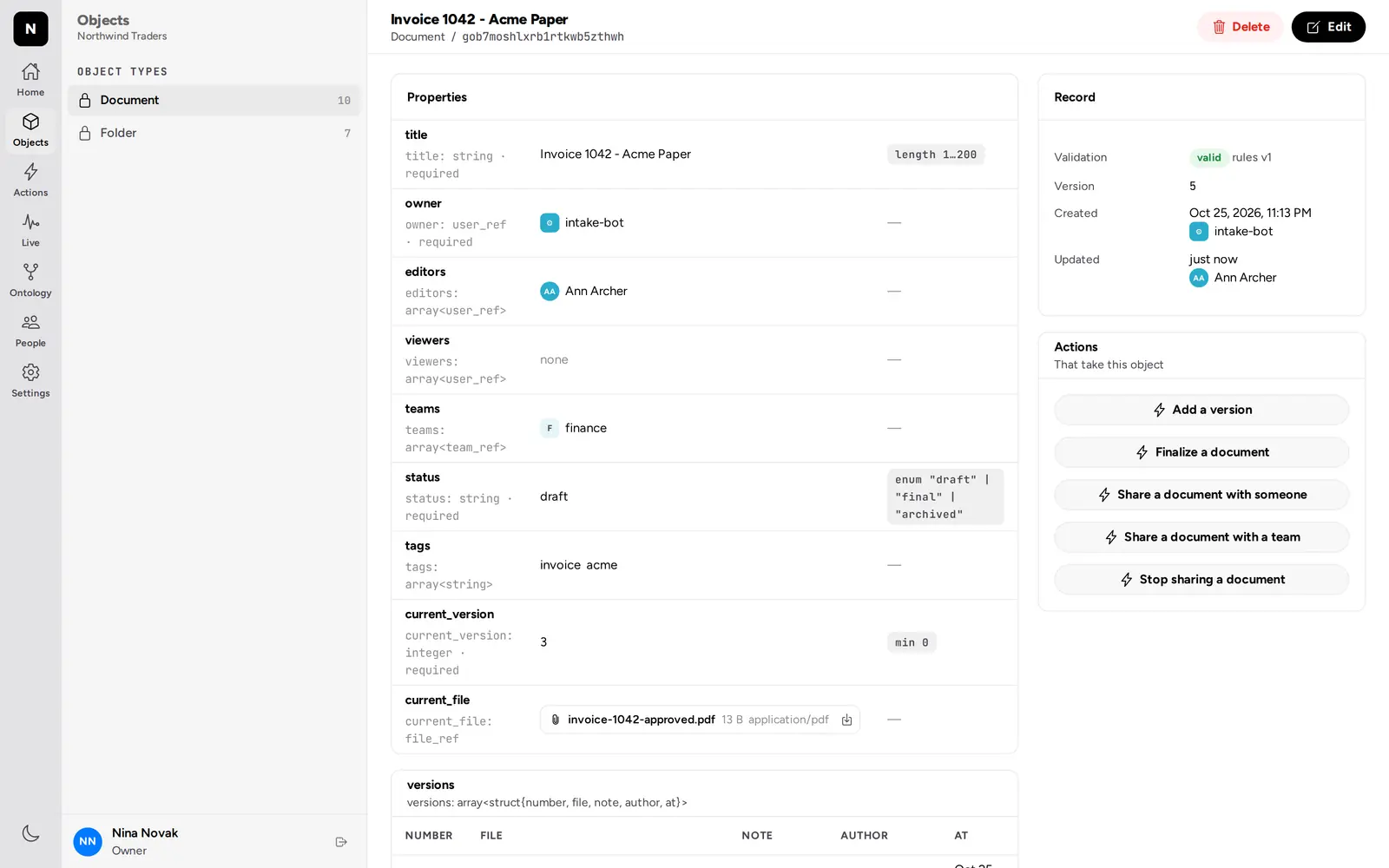
document | title, owner, editors and viewers (lists of users), teams (a list of teams), status: draft, final, or archived; tags, current_version, current_file, versions |
versions is a list of structs, one per version:
{ "api_name": "versions", "type": { "kind": "array", "items": { "type": { "kind": "struct", "fields": [
  { "api_name": "number", "type": { "kind": "integer" }, "required": true },
  { "api_name": "file",   "type": { "kind": "file_ref" }, "required": true },
  { "api_name": "note",   "type": { "kind": "string" } },
  { "api_name": "author", "type": { "kind": "user_ref" }, "required": true },
  { "api_name": "at",     "type": { "kind": "timestamp" }, "required": true } ] } } } }
Each version’s file is an attachment,
uploaded with POST /v1/files. Whoever can see the document can read every
one of its files, and nobody else can.
| Link type | From → to | Cardinality | Names |
|---|---|---|---|
folder_parent | folder → folder | many to one | parent / subfolders |
document_folder | document → folder | many to one | folder / documents |
The owner seeds four folders:
| Folder | Shared with |
|---|---|
| Company | the everyone team |
| Finance | the finance team |
| Invoices, inside Finance | the finance team |
| Sales | Ann and Ben |
Who sees what
Both types are restricted, with the people and teams they name as their access properties:
PUT /v1/ontology/object-types/document/access
{ "restricted": true,
  "access_properties": ["owner", "editors", "viewers", "teams"],
  "grants": [
    { "team_id": "<everyone>", "permission": "view_objects", "scope": "assigned" },
    { "team_id": "<records>", "permission": "view_objects" } ] }
Folders are the same, with owner, shared_with, and shared_teams. So
every member sees the folders and documents that name them or a team they
are on, and records sees all of them. Ben sees Company and Sales; Ann sees
all four folders; the agent sees Company, Finance, and Invoices.
Postgres enforces it. A document that is not shared with Ben does not exist for Ben by any route, and neither do its files.
The drive
Beside the documents, drive is a
filesystem type: one tree of folders and
files, every write of a file a version, with deleted items kept for 14
days.
{ "api_name": "drive", "display_name": "Drive", "kind": "filesystem",
  "properties": [], "filesystem": { "trash_days": 14 } }
The owner creates /Company, /Finance, and /Finance/Invoices, and
restricts /Finance:
PUT /v1/fs/nodes/<finance folder>/access
{ "restricted": true,
  "grants": [ { "team_id": "<finance>", "level": "write" },
{ "team_id": "<records>", "level": "read" } ] }| Who | Sees | May |
|---|---|---|
| everyone | /Company | read it; only finance holds edit_objects, which writing needs |
finance | /Company, /Finance and everything in it | write both |
records | /Company, /Finance and everything in it | read both |
To Ben, /Finance and everything in it do not exist, by any route.
The actions
| Action | Who, per its criteria | Does |
|---|---|---|
create_document | anyone, in a folder they see | files a document owned by the caller as a draft, with version 1 if a file is given, and links it to the folder |
add_version | the owner and editors | appends the next version, makes it current, and puts a final document back to draft; not for archived ones |
share_document | the owner; editors may add viewers | adds a person as viewer or editor, and emails them |
share_with_team | the owner and editors | lets a whole team view the document |
unshare_document | the owner | removes a person or a team |
finalize_document | the owner, for a draft with a version | sets the document final and sends a webhook to the records archive |
All six are granted to everyone. Who may do what is in their criteria,
because it depends on the document: being its owner or one of its editors.
share_document
A Python criterion decides who may share, and Python edits move the person between the two lists:
def check(ctx):
    doc = ctx['objects']['document']['properties']
    me = ctx['caller']['id']
    role = ctx['params']['role']
    if ctx['params']['user'] == doc['owner']:
        return 'the owner already has the document'
    if doc['owner'] == me:
        return True
    if me in (doc.get('editors') or []) and role == 'viewer':
        return True
return 'only the owner shares a document, and editors may only add viewers'def edits(ctx):
doc = ctx['objects']['document']['properties']
user = ctx['params']['user']
editors = [u for u in (doc.get('editors') or []) if u != user]
viewers = [u for u in (doc.get('viewers') or []) if u != user]
if ctx['params']['role'] == 'editor':
editors = editors + [user]
else:
viewers = viewers + [user]
return [{'op': 'update_object', 'object': {'param': 'document'},
'properties': {'editors': editors, 'viewers': viewers}}]"effects": [
{ "kind": "email", "to": { "param": "user" },
"subject": "{{object.document.title}} was shared with you",
"text": "You are now a {{param.role}} of {{object.document.title}}." }
]add_version
A declarative criterion and a Python one:
"criteria": [
  { "name": "not_archived", "message": "archived documents get no new versions",
    "condition": { "op": "ne", "left": { "object": "document", "property": "status" },
                   "right": { "value": "archived" } } },
  { "name": "editor",
    "code": "def check(ctx):\n    doc = ctx['objects']['document']['properties']\n    me = ctx['caller']['id']\n    if doc['owner'] == me or me in (doc.get('editors') or []):\n        return True\n    return 'only the owner and editors add versions'\n" }
]def edits(ctx):
doc = ctx['objects']['document']['properties']
number = doc['current_version'] + 1
version = {'number': number, 'file': ctx['params']['file'],
'author': ctx['caller']['id'], 'at': ctx['now']}
if ctx['params'].get('note') is not None:
version['note'] = ctx['params']['note']
versions = (doc.get('versions') or []) + [version]
changes = {'versions': versions, 'current_version': number,
'current_file': ctx['params']['file']}
if doc['status'] == 'final':
changes['status'] = 'draft'
return [{'op': 'update_object', 'object': {'param': 'document'}, 'properties': changes}]The file parameter is a file_ref, so the caller must be able to read the
file: one they uploaded, or one already on an object they can see.
Setting it up
As an owner, through the REST API:
- Create the
financeteam, withedit_objects, and therecordsteam, with no permissions (teams API). Add Ann and the agent tofinance, and Cleo torecords. - Create the object types and link types (schema API), and restrict both types as above.
- Create the six action types and grant each to
everyone(actions API). - Create the four folders.
- Create the
drivetype, its three folders, and restrict/Finance(filesystem API).
1. The agent files an invoice
intake-bot uploads the scan:
POST /v1/files?name=invoice-1042.pdf
Authorization: Bearer heat_...
Content-Type: application/pdf

201 { "id": "<scan>", "purpose": "attachment", "name": "invoice-1042.pdf", ... }
Only the agent can read the file so far. It also puts a copy in the drive’s
/Finance/Invoices:
PUT /v1/fs/nodes/<drive invoices>/files/invoice-1042.pdf
Content-Type: application/pdf

201 { "id": "<drive invoice>", "path": "/Finance/Invoices/invoice-1042.pdf",
      "content_version": 1, "level": "write", ... }
It files the document in Invoices with the scan as version 1:
POST /v1/actions/create_document/apply
{ "params": { "title": "Invoice 1042 - Acme Paper", "folder": "<invoices>",
              "file": "<scan>", "note": "Scanned", "tags": ["invoice", "acme"] } }

201 { "created": [{ "type": "document", "ref": "document", ... }], ... }
The agent owns the document, so it sees it. Then it shares it with
finance, with an idempotency key:
POST /v1/actions/share_with_team/apply
{ "params": { "document": "<invoice>", "team": "<finance>" },
  "idempotency_key": "share-1042" }

201 { "application_id": "<a2>", "replayed": false, ... }
The answer is lost, so it sends the same request again: 200 with
replayed: true and the same application_id. Nothing is applied twice.
2. Finance reads it; Ben does not
Ann is in finance, so Ann reads the invoice and downloads its scan:
GET /v1/ontology/objects/document/<invoice> and GET /v1/files/<scan>
are both 200. For Ben, not in finance, both are 404: to Ben neither
the document nor the file exists.
Denied. Ann tries to change the title directly:
PATCH /v1/ontology/objects/document/<invoice>
{ "properties": { "title": "x" } }

403 { "error": { "code": "forbidden", ... } }
Ann’s team holds edit_objects, but the document type is restricted and
grants it to nobody: documents change only through actions.
Refused by a criterion. Ann uploads an approval stamp and tries to add it as a version. Seeing the document through a team makes Ann a viewer, not an editor:
422 { "error": { "code": "criteria_failed",
      "details": [{ "path": "criteria.editor",
                    "message": "only the owner and editors add versions" }] } }
3. Two versions at once
The agent makes Ann an editor (share_document, role editor), and Ann is
emailed “Invoice 1042 - Acme Paper was shared with you”. Ann reads the
document and notes its version, 3.
Meanwhile the agent uploads a better scan, writes it as the next version of
the drive’s copy (PUT /v1/fs/nodes/<drive invoice>/content: 200,
content_version 2), and adds it to the document, stating the version it
read:
POST /v1/actions/add_version/apply
{ "params": { "document": "<invoice>", "file": "<rescan>", "note": "Better scan" },
  "expected_versions": { "document": 3 } }

201 { "updated": [{ "type": "document", "version": 4, ... }], ... }
Conflict. Ann adds the approval against version 3, read before the rescan. Nothing is applied:
409 { "error": { "code": "version_conflict",
      "details": [{ "path": "params.document", "message": "..." }] } }
Ann reads the document again and retries with version 4: 201. The
document now has three versions, by the agent, the agent, and Ann, and
current_file is Ann’s approval. Every version’s file can be read by everyone
who sees the document, including the scan the agent uploaded.
4. Ann shares a budget with Ben
Ann uploads q3-budget.pdf, files it in Sales with create_document, and
shares it with Ben as a viewer:
POST /v1/actions/share_document/apply
{ "params": { "document": "<budget>", "user": "<ben>", "role": "viewer" } }

201 { ... }
Ben is emailed “Q3 budget was shared with you”. Ben can now download the
budget’s file, but still not the invoice’s (404).
5. Ben’s assistant
Ben connects an MCP client and grants it ontology:read actions:apply files:read.
Asked for every document (query_objects on document, no filter), it gets
one: the budget. Asked for folders, it gets Company and Sales. A search for
budget in titles finds the same document:
{ "tool": "query_objects",
  "arguments": { "type": "document",
                 "filter": { "op": "contains", "property": "title", "value": "budget" } } }
Asked for the invoice by id (get_object), it gets an error: the invoice
does not exist for Ben.
Search says the same. With ontology:read and
files:read, the search tool looks through documents, folders, and the
drive. budget finds the budget; invoice finds neither the invoice nor
the drive’s copy of it, which exist only for finance and records:
{ "tool": "search", "arguments": { "query": "invoice" } }

→ { "results": [], "kinds": ["object", "file"], "next_cursor": null }
In the drive, it finds only Company:
{ "tool": "list_files", "arguments": { "type": "drive" } }

→ { "children": [ { "name": "Company", "kind": "folder", "level": "read", ... } ], ... }
Asked for the drive’s copy of the invoice by path, it gets not_found, as
it would for a file that was never written:
{ "tool": "read_file",
  "arguments": { "type": "drive", "path": "/Finance/Invoices/invoice-1042.pdf" } }

→ error { "code": "not_found", ... }
Ben’s own GET /v1/fs/nodes/<drive invoice> is 404 too.
Refused by a criterion. Asked to make Ben an editor, it tries anyway:
{ "tool": "action_share_document",
  "arguments": { "document": "<budget>", "user": "<ben>", "role": "editor" } }

→ error { "code": "criteria_failed",
          "details": [{ "path": "criteria.may_share",
                        "message": "only the owner shares a document, and editors may only add viewers" }] }
Adding a version is refused the same way, at criteria.editor.
Denied. It tries to create a document of its own with create_object:
forbidden. Ben holds no edit_objects, and the grant has no
ontology:write.
6. Records, and the end of sharing
Cleo, in records, sees both documents, whoever owns them, but may not
finalize one:
422 { "error": { "code": "criteria_failed",
      "details": [{ "path": "criteria.owner",
                    "message": "only the owner finalizes a document" }] } }
In the drive, Cleo reads the invoice’s copy at level read, lists its two
versions (GET .../versions: 2, then 1), and downloads the first scan
(GET .../content?version=1). Writing a stamped copy is 403: records
may only read /Finance. For Ann, in finance, the same file shows level
write.
Ann, the budget’s owner, finalizes it: 201, and after commit the records
archive’s webhook is sent. Then Ann stops sharing it with Ben:
POST /v1/actions/unshare_document/apply
{ "params": { "document": "<budget>", "user": "<ben>" } }

201 { ... }
At once, Ben’s assistant finds no documents, and Ben’s download of
the budget’s file is 404.
What everyone saw
The audit log (GET /v1/action-applications) holds nine applications:
| Action | By | Via |
|---|---|---|
create_document | intake-bot | rest, api_token |
share_with_team | intake-bot | rest, api_token |
share_document (Ann as editor) | intake-bot | rest, api_token |
add_version (rescan) | intake-bot | rest, api_token |
add_version (approval) | Ann | rest, session |
create_document (budget) | Ann | rest, session |
share_document (Ben as viewer) | Ann | rest, session |
finalize_document | Ann | rest, session |
unshare_document | Ann | rest, session |
The replayed share and every refused call appear nowhere: they changed nothing. The background job sent the two “was shared with you” emails and the archive’s webhook.
What this shows
- Sharing is data. Who sees a document is in its own properties, users and teams alike, and the database enforces it for every read, query, event, action, and MCP tool.
- Files follow the objects that refer to them. Sharing a document shares every version’s file, and unsharing it ends that at once. There is no separate file permission to keep in step.
- The rules live in the actions. Who may add a version, share, or finalize depends on the document, and every client, the agent’s, Ann’s, and Ben’s assistant, meets the same rules.
- Teams change access in one place. Adding someone to
financeshows them every invoice shared with it; removing them hides those at once. - Concurrent edits do not overwrite each other. The second version stated what it read, and was refused until it read again.
- A restricted folder hides everything in it. The drive’s
/Financeis seen by finance and records only, and each reads or writes there at the level its grant gives. Ben’s assistant cannot list, find, or read anything in it.
What it does not do yet
- Folder objects do not pass their sharing on. Each document carries its own access properties. Sharing a folder does not share its documents, and an action cannot yet update objects it was not given. The drive’s restricted folders do cover everything in them, but grant teams only, not single people.
- No share links. Everyone who reads a document is a member of the organization.
- Attachments are not searched. Search finds titles, tags, and the drive’s names and text files, but not what is inside the scanned PDFs.
- MCP clients cannot upload attachments. They can refer to files their
user can already read, and with
files:writethey could write files in the drive. - No upload quota, and attachments that no object refers to are kept.